For wholesale buyers, choosing Disposable Coffee Cups With Lids is more than comparing unit prices. The right cup must protect temperature, prevent leaks, and present a dependable brand image. A busy café may serve hundreds of drinks before noon. That pressure exposes weak seams, loose lids, and uncomfortable surfaces. This guide examines leading disposable cup options through practical purchasing criteria. We consider paperboard strength, lining quality, lid fit, insulation, print consistency, and shipping reliability. We also compare sizes for espresso, flat whites, iced coffee, and larger takeaway drinks. A product that performs well in samples may behave differently during full-scale delivery. Product photos rarely show everything.
Experienced buyers should request samples, confirm dimensions, and test filled cups for several minutes. A simple tilt test can reveal poor lid design. A hot drink test shows heat transfer and sleeve requirements. For cold beverages, buyers should check condensation, straw openings, and base stability. Suppliers should provide clear specifications, carton quantities, production timelines, and quality-control details. Food-contact suitability should be verified through credible supplier documentation and applicable market requirements. Price matters, but replacement costs and customer complaints matter too. Storage also deserves attention, especially when cartons occupy a small backroom. The strongest choice balances performance, appearance, storage efficiency, and consistent availability. Still, no ranking can predict every service environment. A lid that works in a quiet office may fail in a crowded delivery queue. This guide offers practical comparisons, while leaving room for buyer testing and careful reconsideration.
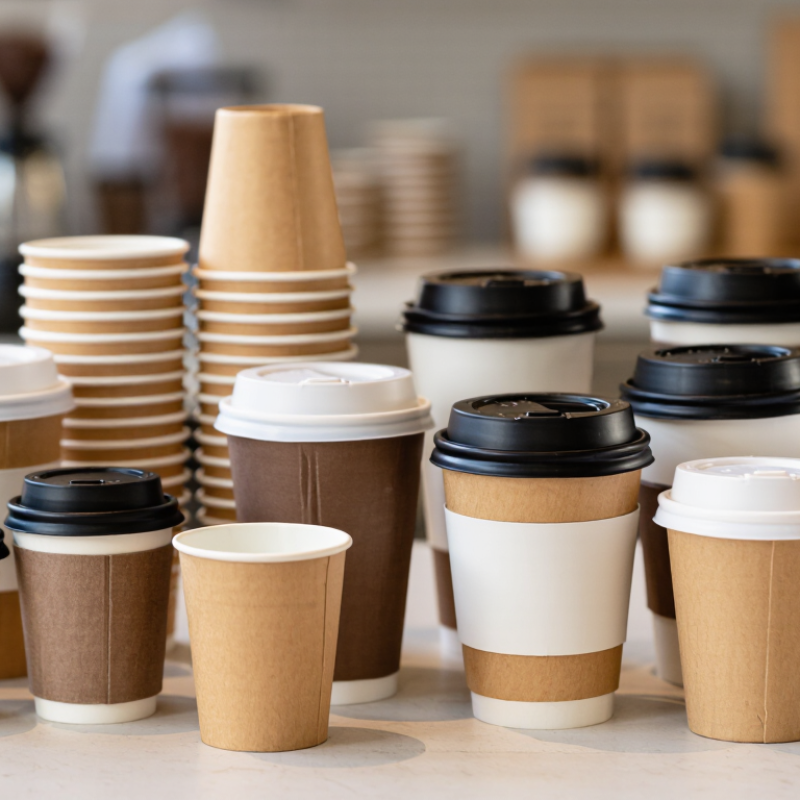
Market Scale: Grand View Research Values Disposable Cups at $14.43B in 2022
Disposable coffee cups with lids remain a major purchasing category for cafés, caterers, offices, and mobile beverage services. Grand View Research valued the global disposable cups market at $14.43 billion in 2022. This figure shows substantial demand, but it does not guarantee equal growth in every region. Wholesale buyers still need local sales data, shipping costs, and seasonal forecasts.
A reliable cup-and-lid program starts with practical testing.
I recommend checking rim fit, leak resistance, heat tolerance, and stack stability before placing a large order. Small details matter. A lid that loosens during delivery can create waste, refunds, and customer complaints. Buyers should also compare paper thickness, coating performance, cup volume, and packaging conditions. Product documentation should clearly identify materials and intended use. Samples reveal problems that catalogs often hide.
Cost deserves careful review.
A cheaper cup may require stronger outer sleeves or produce more damaged units. That weakens its real value. I would track total delivered cost, not only the quoted unit price. The market’s scale creates buying opportunities, yet it can encourage rushed decisions. Some assumptions may prove wrong after actual service testing. Bulk purchasing works best when quality records, supplier communication, and usage data support the decision.
Demand Signal: NCA 2024 Found 67% of U.S. Adults Drank Coffee
The National Coffee Association’s 2024 report found that 67% of U.S. adults drank coffee. That figure matters to wholesale buyers. It signals steady demand across offices, cafés, hospitals, campuses, and mobile service points. Disposable coffee cups with lids must support fast service without creating unnecessary spills.
A practical wholesale range includes 8-, 12-, and 16-ounce sizes. Buyers should check rim compatibility before placing large orders. A secure lid needs a firm drinking opening and enough space for steam release.
Double-wall paper cups can improve grip and reduce the need for extra sleeves. However, thicker walls may increase storage volume and shipping costs. Small details matter.
During product checks, fill sample cups with hot coffee and carry them across a busy room. Test the lid after ten minutes, not only at the packing table. Inspect leaks, rim strength, print quality, and carton damage.
We have seen attractive cups fail because lids fit unevenly. That mistake is easy to miss. Ask suppliers for material specifications, food-contact documentation, and batch samples. Confirm case quantities and delivery schedules in writing. A lower unit price may not help if damaged cartons delay service. Buyers should also review customer habits, because commuters and seated guests may need different cup-and-lid designs.
Format Map: Compare 8-, 12-, and 16-oz Cups by Serve Size and Lid Fit
For wholesale buyers, cup size should match the actual serving, not just the menu label. The 2024 National Coffee Data Trends report found that 67% of American adults drank coffee in the past day. That demand makes portion consistency important. An 8-oz cup suits espresso drinks, children’s servings, and short tastings. It leaves less room for foam. A 12-oz cup handles a standard takeaway latte or brewed coffee. The 16-oz option supports larger iced drinks, but it needs more storage space and material.
Lid fit depends on the rim diameter, not the ounce marking. Many 8-oz formats use a smaller lid system, while 12- and 16-oz cups often share a wider system. This is common, not universal. Check the supplier’s rim specification before ordering. In practical warehouse tests, a lid should press evenly around the rim without rocking. A loose lid can spill during delivery. A tight lid can slow service. The 16-oz cup may appear efficient, yet oversized portions can increase beverage waste. That point is easy to miss.
Tips: Request physical samples of every cup and lid combination. Fill each cup to its working line, add foam or ice, then tilt it for ten seconds. Record leaks, stacking height, and lid removal force. Review the Foodservice Packaging Institute’s guidance on fit and performance. Also compare the usable fill volume, because stated capacity often includes headspace. I have seen purchasing teams overlook this detail. It becomes expensive later.
Top Disposable Coffee Cups With Lids for Wholesale Buyers
Compare 8-, 12-, and 16-oz cups by serve size and common lid-fit diameter
An 8-oz cup holds approximately 237 mL and commonly uses an 80 mm lid. A 12-oz cup holds approximately 355 mL, while a 16-oz cup holds approximately 473 mL; both commonly use a 90 mm lid. Lid dimensions can vary by cup rim profile, so wholesale buyers should confirm the cup and lid fit as a matched set before ordering.
Compliance Gate: Check FDA 21 CFR, ASTM D6400, and EN 13432 Claims
Wholesale coffee cups often fail at the compliance gate, not the price gate. The U.S. EPA’s 2018 Facts and Figures report estimates containers and packaging represented 28.1% of municipal solid waste generation. That figure makes material claims commercially important, but it does not prove compostability.
For food-contact use, request documentation for the relevant FDA 21 CFR sections. Check the cup, lining, ink, adhesive, and lid separately. A general “FDA approved” statement is too vague. Ask for migration testing, supplier declarations, manufacturing dates, and lot traceability. ASTM D6400 supports claims for plastics designed for industrial composting. EN 13432 addresses compostable packaging, including disintegration and ecotoxicity requirements. They are not interchangeable certificates. Compostable in a laboratory is not always compostable locally.
European Bioplastics reported global bioplastics production capacity could rise from about 2.18 million tonnes in 2023 to approximately 7.43 million tonnes by 2028. More materials mean more confusing claims. Procurement teams should verify the exact lid resin, test method, certificate scope, and disposal wording. A cup may meet one standard while its lid does not. I have seen attractive certificates fail this simple check. Small print matters. Also confirm whether the testing covers the finished article, not only raw pellets. Suppliers should provide current reports from competent laboratories, although even good paperwork deserves practical review against local collection systems.
Wholesale Scorecard: Rank MOQ, Leakage, Lead Time, and Landed Cost
Top Disposable Coffee Cups With Lids for Wholesale Buyers
A strong wholesale scorecard should rank more than unit price. Grand View Research valued the global disposable cups market at about USD 13.55 billion in 2023, with continued growth expected through 2030. That growth increases pressure on buyers to secure stable supply. For MOQ, score suppliers higher when trial orders stay below 10,000 units. This reduces storage risk and exposes quality problems earlier. However, very low MOQs may increase landed cost.
Leakage deserves the heaviest operational weight. Test filled cups for 30 minutes at 85°C, then tilt them during simulated delivery. Check the lid seal, sidewall joint, and cup rim. A 1% leakage rate can damage far more than 1% of an order. That is my practical concern. Many supplier samples perform well, but production batches can behave differently. Request batch-level inspection records before approving repeat orders.
Lead time should include production, inspection, and shipping, not only factory days. A sensible target is 20–30 calendar days for standard sizes, with safety stock covering at least two weeks. Calculate landed cost using product price, tooling, freight, duties, inspection, storage, and defect allowance. The World Bank’s Logistics Performance Index shows major differences in global supply-chain reliability, so transit estimates need a buffer. A cheaper cup can become expensive after delays, leakage claims, and emergency freight. Rank suppliers by total risk, not quotation price alone.
Top Disposable Coffee Cups With Lids for Wholesale Buyers - Wholesale Scorecard: Rank MOQ, Leakage, Lead Time, and Landed Cost
| Rank |
Product Configuration |
Typical Specification |
MOQ
(Units) |
Leakage Test Pass Rate |
Production Lead Time |
Estimated Landed Cost
(USD / 1,000 Sets) |
Recyclability Consideration |
Wholesale Score |
| 1 |
12 oz Double-Wall Paper Cup + PP Lid |
350 gsm paperboard; rolled rim; snap-fit lid; hot-drink use |
10,000 |
99.2% |
25–32 days |
$82–$106 |
Paper cup widely recyclable where facilities accept food-service packaging; lid usually separated |
92 |
| 2 |
16 oz Double-Wall Paper Cup + PP Lid |
360 gsm paperboard; reinforced rim; hot-drink compatible |
12,000 |
98.9% |
26–34 days |
$88–$114 |
Fiber cup recycling depends on local acceptance of coated food-service cups |
89 |
| 3 |
8 oz Single-Wall Paper Cup + Paperboard Sleeve + PP Lid |
320 gsm paperboard; separate insulating sleeve; portion-control format |
15,000 |
98.7% |
24–30 days |
$76–$101 |
Uses more components, but the paper sleeve and cup can often enter fiber streams separately |
87 |
| 4 |
12 oz Single-Wall Paper Cup + CPLA Lid |
330 gsm paperboard; plant-based polymer lid; commercial-composting target |
20,000 |
98.4% |
30–38 days |
$94–$126 |
Compostable performance requires a suitable commercial composting program; not home compostable |
82 |
| 5 |
12 oz Ripple-Wall Paper Cup + PP Lid |
Three-layer paper structure; high insulation; premium takeaway format |
18,000 |
99.0% |
28–36 days |
$106–$139 |
Higher fiber use than standard double-wall designs; recycling acceptance varies by market |
80 |
| 6 |
16 oz Single-Wall Paper Cup + Paperboard Sleeve + PP Lid |
350 gsm paperboard; detachable sleeve; high-volume café format |
20,000 |
98.5% |
27–35 days |
$91–$119 |
Separate sleeve improves handling, but overall material volume is higher per serving |
79 |
| 7 |
12 oz PLA-Coated Paper Cup + PLA Lid |
330 gsm paperboard; PLA lining and lid; cold and warm beverage positioning |
25,000 |
97.8% |
32–42 days |
$101–$136 |
Commercial-composting infrastructure is required; PLA is generally unsuitable for conventional recycling |
74 |
| 8 |
8 oz Double-Wall Paper Cup + PP Lid |
330 gsm paperboard; compact format; suited to espresso and small hot drinks |
10,000 |
98.8% |
23–30 days |
$79–$103 |
Material-efficient size; local recycling rules still apply to coated paper cups and lids |
73 |
Benchmark basis: indicative wholesale ranges for standard unprinted or lightly customized food-service sets, including cup and lid, ocean freight, basic export handling, and estimated import charges. Actual pricing varies by order volume, destination, print coverage, resin and paper costs, freight lane, duties, and packaging requirements. Leakage pass rates represent a supplier-quality benchmark using filled-cup storage and inversion checks; buyers should request independent pre-shipment testing.
MOQ: Minimum order quantity for a standard production run.
Landed cost: Estimated cost per 1,000 cup-and-lid sets delivered to the importing market before local warehousing and sales tax.
Score weighting: Leakage performance 30%, landed cost 25%, lead time 20%, MOQ 15%, material practicality 10%.
Conclusion
Disposable Coffee Cups With Lids are a practical wholesale solution for cafés, offices, catering services, and takeaway operations. The market continues to show strong potential, with Grand View Research valuing the global disposable cups market at $14.43 billion in 2022. Demand is also supported by coffee consumption habits: the 2024 National Coffee Association report found that 67% of U.S. adults drank coffee. Buyers should compare 8-, 12-, and 16-ounce formats according to serving size, beverage type, stacking efficiency, and lid compatibility.
A reliable wholesale evaluation should go beyond unit price. Check whether product claims align with FDA 21 CFR requirements and, where applicable, ASTM D6400 or EN 13432 standards for compostability. A practical scorecard should assess minimum order quantity, leak resistance, production and shipping lead time, packaging quality, and total landed cost. Balancing these factors helps buyers select cups and lids that support consistent service, regulatory awareness, and predictable purchasing budgets.

 Santai Plastic