Global coffee consumption is expanding, and convenience continues to shape packaging decisions. The International Coffee Organization reported world coffee consumption at approximately 177 million 60-kilogram bags in 2023/24. That scale creates steady demand for reliable takeaway packaging.
This guide examines 2026 Plastic Coffee Cups With Lids for global buyers. It focuses on practical performance, not attractive product photographs alone. Grand View Research identifies continued growth in the disposable cups market, supported by cafés, delivery services, offices, and quick-service restaurants. Yet growth does not remove purchasing risks. A cup may appear strong but soften beside a hot espresso machine. A lid may click firmly but leak during a six-minute motorcycle delivery.
Material selection matters. Polypropylene and PET offer different balances of heat resistance, clarity, stiffness, and recycling compatibility. Buyers should verify food-contact documentation, temperature limits, dimensional tolerances, and packaging test records. Supplier audits remain valuable, especially when production changes between samples and bulk orders.
Environmental claims require caution. The OECD reported that only about 9% of global plastic waste was recycled in 2019. Therefore, “recyclable” should not be accepted without checking local collection systems, material composition, and labeling rules. This point is often overlooked.
The strongest sourcing decision may not be the cheapest unit price. It may be the cup that reduces spills, protects beverage quality, and performs consistently across climates. Still, no single design fits every market. Buyers should test real drinks, real lids, and real transport conditions before approving large orders.
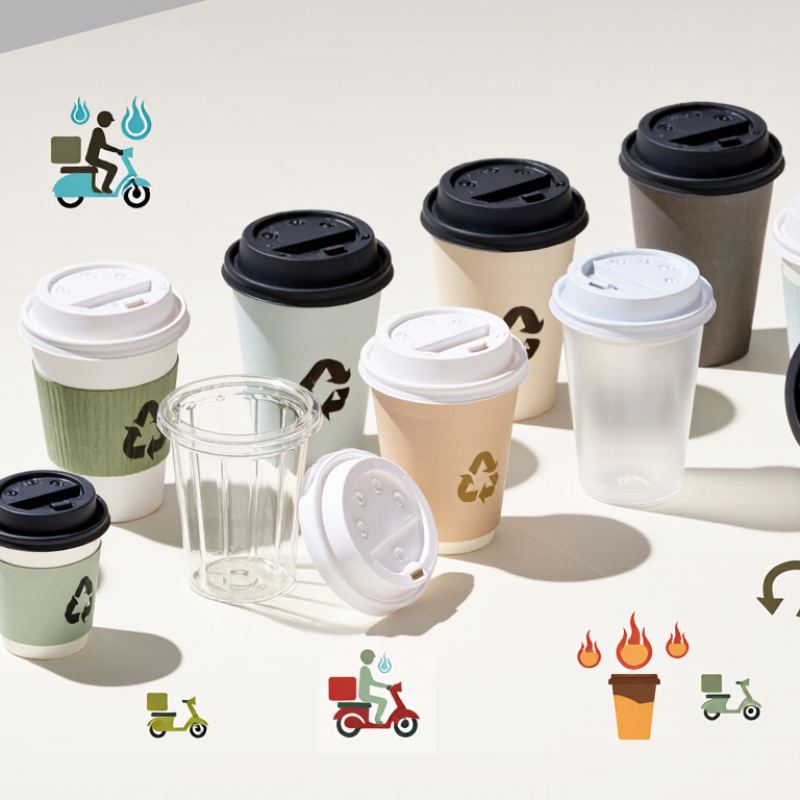
Global buyers need more than attractive disposable drinkware. The real product scope includes plastic coffee cups, compatible lids, sealing performance, material choices, and export documentation. OECD’s Global Plastics Outlook reports that the world generated 353 million tonnes of plastic waste in 2019. Packaging represented about 40 percent. That figure makes cup and lid selection a procurement issue, not merely a design decision.
A reliable system should match cup diameter, lid fit, stacking height, and beverage temperature. Cold-drink lids may fail when used with hot coffee. Small vent openings can reduce pressure, but they may also release aroma and heat too quickly. Procurement teams should request leak tests, drop tests, migration documentation, and batch samples. Check the rim by hand. It should feel even, not sharp or flexible. Material claims also require caution. “Recyclable” depends on local collection and sorting infrastructure, which differs widely between markets.
UNEP’s 2023 report, Turning off the Tap, identifies packaging as a major target for reducing plastic pollution. Buyers can compare lightweighting with structural strength, because thinner is not automatically better. A 0.2-gram saving may matter at large volumes, yet a weak lid can create spills, returns, and customer complaints. Specifications should state resin type, capacity, wall thickness, lid tolerance, carton quantity, and storage conditions. Some assumptions deserve review. A low unit price may hide higher freight damage or inconsistent fitting. Test the complete cup-and-lid system, not isolated components.
Evaluate the cup, lid, seal, material, stacking height, and export documents together. Appearance alone proves very little.
Fill the cup to its marked capacity and close the lid firmly. Invert it for 60 seconds, then shake it gently. Check the rim, drinking opening, and base for drips or condensation.
Not always. Heat may soften the lid or weaken its seal. Test the complete system at the intended beverage temperature, such as 85°C.
The rim should feel even, smooth, and firm. The wall should resist crushing without feeling unnecessarily thick. A stable cup stacks evenly.
No. Lightweighting can reduce material use, but excessive thinness may cause crushing, spills, or heat discomfort. A tiny material saving can create larger delivery losses.
Request resin details, capacity, wall thickness, lid tolerance, carton quantity, and storage conditions. Also request food-contact documents, migration results, leak tests, and batch samples.
Recycling depends on local collection and sorting systems. A recyclable label may not mean practical recycling in every market. Check local disposal guidance carefully.
It helps, but it cannot copy every crowded delivery vehicle. Repeat tests with filled cups, tilt movement, and field samples. My assumption may fail here. Real handling deserves more attention.
This guide to 2026 Plastic Coffee Cups With Lids focuses on practical solutions for cafés, distributors, and foodservice buyers worldwide. It covers the product scope, including cup and lid combinations designed for takeaway coffee, cold beverages, and varying service conditions. Since packaging represents a significant share of global plastics demand, buyers should evaluate material efficiency, recyclability, and end-of-life options. The material section compares PP, PET, and PLA, highlighting their different temperature ranges, clarity, rigidity, and suitability under applicable ASTM and EN standards.
Performance is assessed through leak resistance, heat limits, stacking strength, and lid fit testing, helping buyers reduce spills and improve customer safety. Global purchasing decisions should also consider food-contact compliance in destination markets, minimum order quantities, unit cost, shipping requirements, extended producer responsibility data, and documentation quality. By balancing functionality, regulatory readiness, and total cost, buyers can select dependable cup-and-lid systems that support efficient international procurement.

 Santai Plastic